25 Aug 2026
Cross-Discipline Forecasting: Linking Soccer Outcomes, Tennis Matches, and Racing Results via Shared Analytical Frameworks
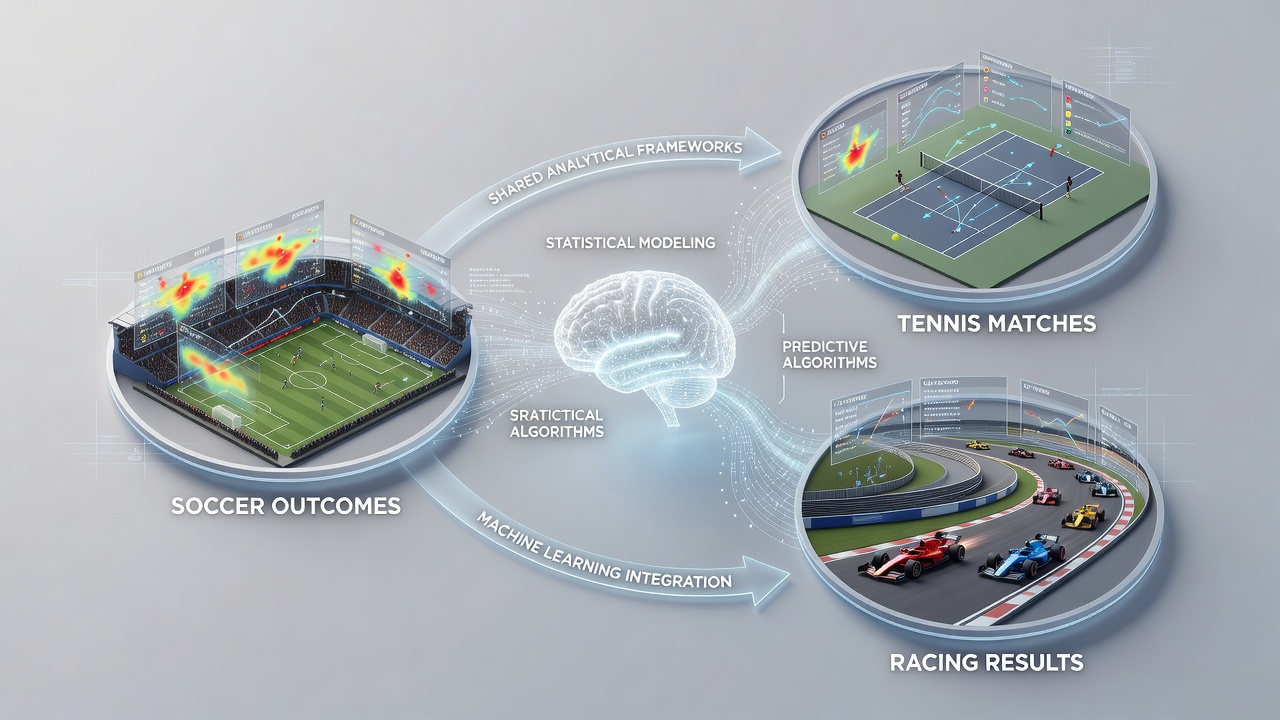
Analysts have developed forecasting methods that transfer across soccer, tennis, and horse racing by adapting core statistical structures to each sport's unique data streams. These frameworks rely on probability distributions, regression adjustments, and machine learning layers that process performance variables in comparable ways. Data from August 2026 shows increased adoption of these approaches during periods when multiple sports overlap in their calendars, including pre-season soccer fixtures, hard-court tennis events, and late-summer racing meetings.
Common Probability Foundations Across Sports
Poisson and negative binomial models form the starting point for many cross-discipline systems because they handle count-based outcomes effectively. Soccer researchers apply these to goal tallies per match while tennis analysts use them for service points won within games and sets. Racing forecasters adapt similar distributions to estimate positions at key race segments by treating each horse's progress as a sequence of timed intervals. Adjustments for home advantage in soccer, surface speed in tennis, and track bias in racing follow parallel logic once the base distribution is selected.
Regression Techniques That Travel Between Domains
Linear and logistic regression appear frequently in studies that compare prediction accuracy across the three sports. Variables such as recent form, opponent strength, and environmental factors receive standardized weighting before sport-specific modifiers are added. One published analysis from the University of Melbourne demonstrated how a single regression pipeline could forecast soccer win probabilities, tennis set outcomes, and racing place percentages by swapping input features without altering the underlying equation structure. This modular design reduces development time when new data sources become available each season.
Time-series components add another shared layer. Exponential smoothing and ARIMA variants track momentum shifts that occur mid-match in soccer and tennis or during race stages in thoroughbred events. Observers note that these methods perform consistently when calibrated against historical datasets spanning multiple years rather than single seasons.
Machine Learning Integration and Feature Engineering
Gradient boosting and random forest algorithms now dominate advanced forecasting platforms because they capture nonlinear interactions that simpler regressions miss. Feature sets often include player or horse ratings, workload metrics, and situational indicators that translate across domains with minimal re-engineering. In August 2026, several European data providers released updated training datasets that combined anonymized soccer event logs with tennis point-by-point records and racing sectional times, allowing models to train on larger pooled samples.

Ensemble methods combine outputs from multiple base models to improve calibration. A forecaster might blend a Poisson-based soccer score predictor with a neural network trained on tennis rally lengths and a survival analysis model for racing finish times. Cross-validation across sports helps identify when one model's strength compensates for another's weakness in specific conditions such as wet tracks or high-altitude venues.
Data Sources and Validation Practices
Public and proprietary datasets supply the raw material for these frameworks. Official league statistics, tournament records, and timing companies provide structured inputs that researchers standardize before model training. Validation occurs through rolling out-of-sample tests that simulate real-time prediction windows. Studies from institutions in Australia and Canada have documented how consistent evaluation protocols improve reliability when the same framework moves from one sport to another.
August 2026 schedules created natural test periods because soccer leagues resumed early fixtures while tennis circuits reached North American hard-court events and several major racing festivals took place simultaneously. Analysts used these overlapping windows to measure transfer performance without waiting for new seasons.
Practical Implementation Patterns
Organizations that maintain multi-sport forecasting systems typically store core model code in shared repositories while keeping sport-specific data pipelines separate. This separation allows quick updates when rules change, such as soccer video assistant referee protocols or tennis tie-break formats. Racing data pipelines often incorporate additional geographic variables like course configuration that have no direct equivalent in the other two sports yet still fit into the same overall architecture.
Performance monitoring relies on metrics such as Brier scores and log-loss that apply equally to binary win predictions in soccer, set-level outcomes in tennis, and place probabilities in racing. Continuous recalibration against fresh results prevents degradation when player or horse populations shift.
Conclusion
Shared analytical frameworks have enabled forecasters to move statistical techniques between soccer, tennis, and racing with measurable efficiency gains. Probability distributions, regression models, and machine learning ensembles provide the connective tissue while sport-specific adjustments preserve accuracy. Data releases and overlapping calendars in periods such as August 2026 continue to supply fresh material for testing and refinement, supporting ongoing development of these cross-discipline approaches.